Localizing the Grid
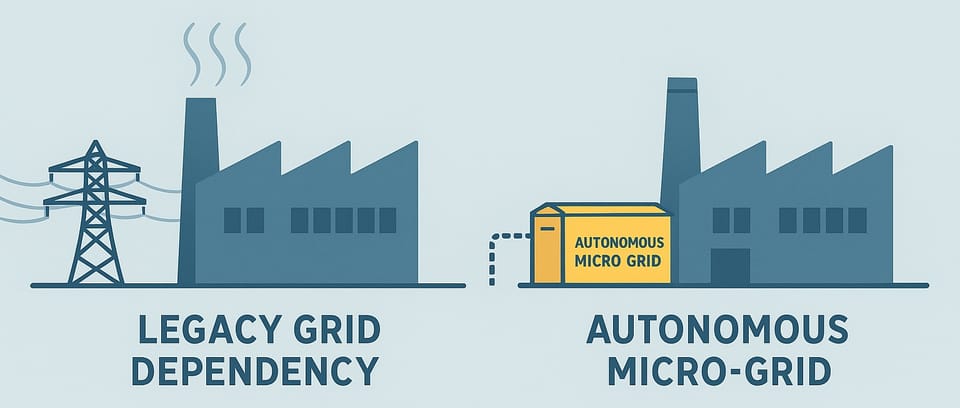
The Quiet Secession of the Digital World
Stand close to any modern data center and you feel it before you hear it.
A steady vibration in the air. The hum of cooling systems running at full tilt. The unmistakable appetite of machines that never sleep. We like to imagine the cloud as something ethereal.
A place without weight or wires.
But the truth is embarrassingly physical.
Behind every large model and every search query sits a warehouse full of heat, metal, and cables thick enough to serve as bridge supports. The digital world is built on a foundation of electricity, and it is beginning to strain against the limits of the old grid built for gentler times.
AI accelerated this collision. What used to be steady load is now a pulse. What used to be predictable is now jagged. What used to be optional uptime is now absolute.
Traditional utilities cannot absorb this change.
Not because they are lazy or shortsighted, but because they were designed for an era when demand grew like a tree, not like a geyser.
This is why the most advanced data centers are beginning to slip quietly out of the grid’s gravitational pull. They are not declaring independence. They are safeguarding continuity. They are becoming power plants in their own right.
And this is the hinge point.
AI data centers are becoming the first energy consumers that cannot rely on the traditional grid. Their demand curves are too sharp, their uptime requirements too strict, and their growth too fast. To keep their systems stable, they begin building local generation. Once that infrastructure exists, everything around it benefits. Hospitals, research labs, and industrial facilities discover that steady, on-site power is not a luxury. It is the simplest path to resilience. In this way, the data center becomes the early adopter for a broader transformation. It creates the conditions in which distributed generation becomes practical, economical, and expected.
Once a local power loop exists, the advantages multiply.
Waste heat becomes usable energy. Cooling becomes part of the power cycle. Load balancing stops depending on distant substations that go dark every time a storm reaches the wrong transformer.
What begins as necessity becomes architecture.
Soon the most critical institutions adopt the pattern because they must. Hospitals cannot lose power during increasingly intense storms. Universities cannot shut down research because the grid had a bad week. Industrial clusters cannot afford production halts caused by distant failures.
Distributed power is not a rebellion. It is a correction. The load traveled upward faster than the spine could strengthen. So the load came home.
The irony is that the loudest critics of data centers call them energy hogs.
The quiet truth is that their survival instinct may drag the rest of us into a saner electrical future. When the first large consumers build their own generation, they create a template that everyone else can follow. They make resilience ordinary instead of exotic.
The grid will not disappear. But it will change. It will become a safety net instead of a life support system. And the digital world, for all its excesses, may be the first sector to remind us that reliable power belongs closest to the people and machines that need it most.
This is how slow revolutions begin.
Not with slogans.
Not with grand plans.
But with a building full of servers that decides it can no longer afford to wait for someone else to keep the lights on.
Pull your chair in a bit.
The sky is next, and there is a layer above the storms that we have forgotten how to use.




Member discussion