Redesigning the Sky
A Policy for Infrastructure Sovereignty
Every century chooses a layer of the world to fight over.
Ours chose the sky. Not the blue horizon or the cloud towers. The orbital shell.
A thin band around the planet that now carries the weight of global communications, weather, navigation, surveillance, and broadband. A band that is filling with satellites, fragments, retired hardware, and the leftovers of decades of launch cycles. A band that has become indispensable and increasingly unstable at the same time.
We pretend that adding thousands more satellites is innovation. Often it is inertia.
We reached orbit because rockets were exciting and regulations were slow. Now we live with the consequences.
There is another approach. Keep the backbone closer to home.
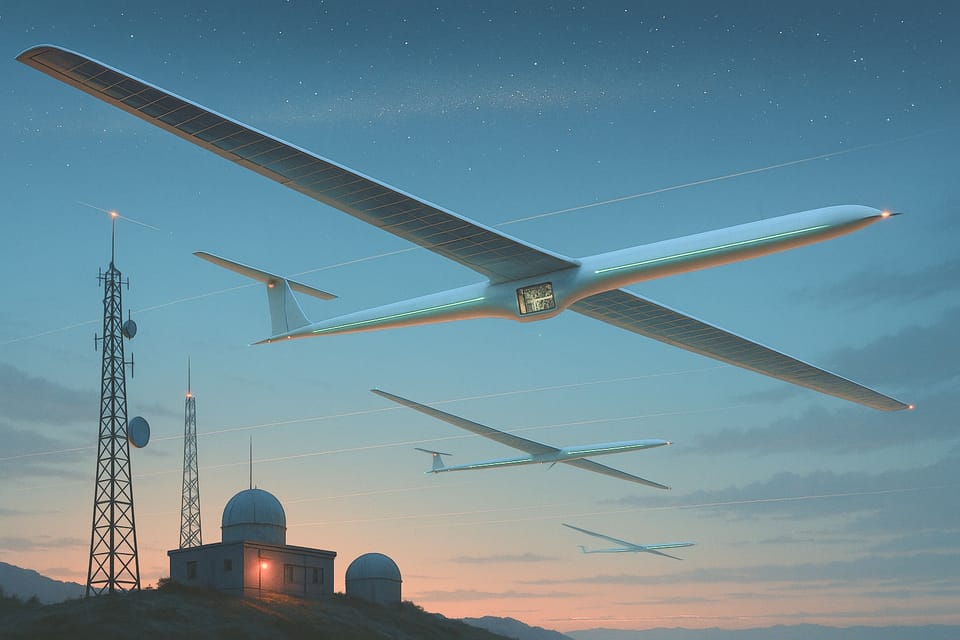
High-altitude drones have been tested for years. The earliest solar endurance flights were built specifically to explore this concept: long-duration aircraft carrying communication payloads. The technology worked. The world did not yet care. The grid was healthier. Orbital debris was manageable. Latency was a niche concern. The urgency was low, and the idea was set aside.
The difference now is simple. The problems that once made the concept optional have matured into constraints that make it worth revisiting.
A modern version of this system would not pretend to escape weather or ATC. It would work with both. You reserve an altitude band above general aviation, carefully deconflicted with commercial traffic, and treat it as managed airspace for uncrewed communication platforms. These drones are filed, tracked, separated, and overseen with the same procedural discipline that keeps conventional aviation safe. They fly predictable routes and follow established control structures.
Weather remains the real obstacle. Thunderstorms grow towers of ice that no aircraft should challenge.
So the design begins by admitting this.
You build extra capacity into the fleet so not every drone has to be on station at the same time. If a storm develops, affected drones divert, descend, reroute, or land before the worst of the system arrives. The goal is not endurance at all costs. The goal is operational safety and controlled degradation.
The network on the ground expects this. Microwave towers and fiber create alternate routes. Traffic flows around temporary gaps with the same fluidity used in terrestrial networks.
Service does not collapse. It adjusts.
This approach also solves a problem most people do not think about: latency. Every signal sent to orbit travels huge distances and returns. Even at the speed of light, that round trip adds measurable delay. Nearly half a second in many cases.
In a world that expects instant response, this is not acceptable.
A stratospheric relay trims that travel time to a fraction. The conversation feels immediate again.
Orbit carries another hidden cost. When a satellite fails, you are stuck with it. Replacement takes months or years. Upgrades require new launches. Repair is impossible. The technology freezes at whatever state it had the day the rocket left the pad.
A stratospheric relay avoids all of that. It can be retrieved, refurbished, or replaced on the ground. It evolves at the pace of the industry instead of the pace of launch windows. The deployment cost is a fraction of a satellite campaign.
The system can grow, iterate, and correct itself without betting millions on every revision. The advantage is not only technical. It is civic.
A country that can repair its own network retains sovereignty over it.
None of this is simple. In fact, this is the most governance-heavy idea in the series. Airspace management is complex. Separation rules must be precise. Maintenance cycles must be consistent. Storm avoidance requires real forecasting. And the legal frameworks for long-duration uncrewed aircraft are still evolving.
This system succeeds only if we treat it with the seriousness of aviation safety and the humility of meteorology. It cannot be sold as a miracle. It can only be built as a commitment.
The sky is not the problem. Our habits are. We reached for orbit out of enthusiasm. We stayed there out of momentum. Now we live in a moment when the quieter, more responsible layer of the sky deserves a second look.
We do not need to conquer the heavens to communicate. We only need to choose an altitude where responsibility is still possible.
Pull your chair in again.
Next we look at the ground, where attention has become the resource most easily stolen and least defended.





Member discussion