The Stack Carrier
Opening to The Kairos Anthology
Rowan left the city before dawn, when the air still pretended to be breathable and the machines hadn’t yet decided what they wanted from him.
Behind him, the towers glowed with the pale confidence of systems that believed they were immortal. The last time he’d checked the grid, the central meter still ticked in steady green. It didn’t matter. He’d watched too many collapses begin with normal status lights.
Every pulse was a transaction. Every thought was a vote someone else counted.
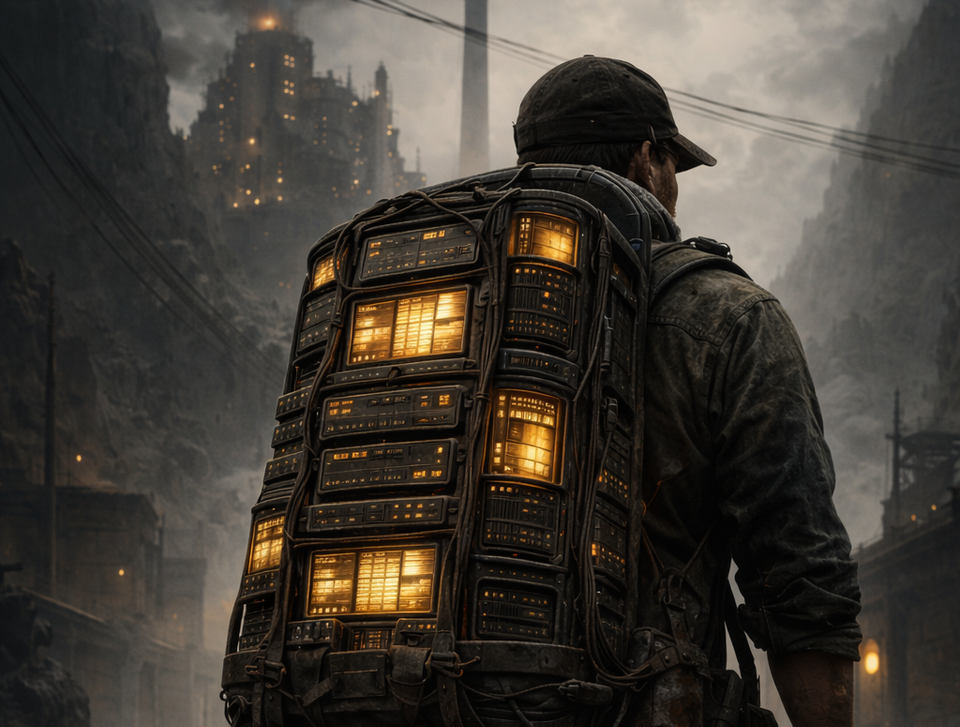
He moved through alleys and sleeping streets with a pack that felt too light for what it contained. It wasn’t food. It wasn’t wealth. It was something stranger.
The Stack.
Not the entire Stack, of course. No one carried the whole world on their back unless they were a liar or a saint, and Rowan was neither. What he carried was the slice that mattered most now: patterns. Repair knowledge. Medical triage. Seed history. Water logic. Old maps. Older warnings. A thousand small truths that didn’t fit neatly into propaganda.
The kind of knowledge that made people dangerous to their own rulers.
He told himself he was taking it somewhere safe.
He did not yet admit what he was really doing.
He was running.
The road out thinned to gravel, then to mud. The forest began as a rumor and then became real, swallowing the last signal bars and the last sense that anyone was watching. Even the drones didn’t like these trees. They didn’t like the way branches broke their lines of sight. They didn’t like the way shadows multiplied.
Rowan walked until his legs stopped negotiating.
Near midday he saw the sign.
It wasn’t placed like an advertisement. It didn’t want to be found. It stood slightly off the road, angled away from the casual traveler, written in plain paint on plain wood.
TRADES AND TALK. NO CREDITS ACCEPTED.
He stared at it for a full breath, because it felt like a joke told by the universe. A punchline with teeth.
No credits accepted. Not even the new emergency tokens. Not even the little digital promises governments issued when they could no longer provide anything else.
Rowan stepped forward anyway.
The road into the place didn’t announce itself. It narrowed. It turned. It hid. In the city, everything wanted to be seen. Here, everything wanted to survive.
A small bell hung from a post and a rope dangled beside it. Rowan stood there long enough to understand the rules without being told.
No cameras. No scanners. No cheerful synthetic voice offering him a menu.
Just a rope. And a choice.
He pulled.
The bell made a sound that wasn’t loud, but it carried. It rang with purpose, not volume.
A man appeared from behind a fence line as if he’d been there the whole time, which meant he had been.
He was older than Rowan, not by decades, but by a kind of calibration. His clothes were practical. His face held the mild suspicion of someone who had been disappointed by civilization and did not intend to be again.
He held a mug of something that smelled faintly like apples and vinegar.
“You lost?” the man asked.
“No,” Rowan said, and that was true in the narrow sense. “I’m looking for the Hollow.”
The man took a slow sip. He did not move aside.
“We don’t call it that out loud,” he said.
Rowan blinked. “Then what do you call it?”
“We call it home,” the man said, as if this were an answer and not a refusal. “Name’s McDuff. I run the Stand, when it runs. And I mind the door, when the door needs minding.”
Rowan nodded. He tried not to look too much like a person who had spent his life with doors that opened for him automatically.
McDuff’s eyes flicked over Rowan’s pack. He didn’t ask what was inside, which was the first kindness and the first warning.
“What brings you here?” McDuff asked.
Rowan could have said food. He could have said shelter. He could have said safety.
Instead he said, “I carry a library.”
McDuff’s mouth tightened, like he was trying not to laugh at a funeral. “Everyone carries a library. Most of it’s garbage.”
“This one isn’t,” Rowan said.
McDuff looked at him for a long moment, and Rowan understood that this was the first test. Not whether he was lying. Whether he was arrogant.
McDuff turned his mug slowly in his hand. “All right,” he said. “You can come in. But first you get Sifted.”
“Sifted,” Rowan repeated.
“Sieved,” McDuff corrected. “We don’t do miracles. We do process.”
Rowan followed him through a simple gate into a settlement that didn’t look like a settlement at first. There were no walls. No towers. No watchtowers. No flags.
The Hollow was not fortified the way a desperate place would be fortified.
It was fortified by being unremarkable.
Homes were built into the curve of the land, not above it. Paths wound like deer trails. A stream ran through the center with a bridge so plain it was almost rude. Smoke rose from cook fires in a way that suggested meals, not industry.
People looked up as Rowan passed, and then looked away.
No one stared as if he were salvation.
No one stared as if he were prey.
That, more than anything, made his throat tighten.
McDuff led him to a low building that smelled of warm grain and yeast. Inside, a woman stood at a table, her hands buried in dough.
She was not young. She was not old. She was simply present.
She looked up once, taking Rowan in, then returned to the work of pressing, folding, and turning, as if she was teaching the dough to remember itself.
“This is Jun,” McDuff said. “Jun will Sieve you.”
Jun did not offer her hand. She nodded toward a basin.
“Wash,” she said. One word. A gate in itself.
Rowan washed.
Jun watched his hands as if she could read his history from the way he rinsed.
“Pack,” she said.
Rowan set the pack down carefully.
Jun gestured for him to open it.
Rowan hesitated. He wanted to say it belonged to him. He wanted to say it was sensitive. He wanted to say it was dangerous.
He wanted to say a dozen things that would reveal what kind of world he came from.
Instead, he unrolled the flap.
Inside were sealed drives. Paper maps in a protective sleeve. A hand-cranked reader. A battered tablet with no network interface, only storage and local compute.
A handful of tools that looked ordinary until you knew what they could do.
Jun’s eyes flicked over it all. She did not ask questions yet. She reached past the technology and picked up one folded paper map.
“This is old,” she said.
“It’s accurate,” Rowan replied.
Jun lifted an eyebrow, the smallest expression of interest.
“Where did you come from?” she asked.
“A city that still thinks it can spreadsheet its way out of famine,” Rowan said before he could stop himself.
McDuff made a sound that might have been a laugh. Or a warning.
Jun set the map down. She returned her hands to the dough. The rhythm of it was steady, like a heartbeat.
“You’re tired,” she said.
“Yes.”
“You’re hungry,” she said.
“Yes.”
“You’re scared,” she said.
Rowan’s jaw tightened.
Jun did not press. She kept kneading.
“That’s not a sin here,” she said. “That’s an input.”
McDuff shifted his weight. “We don’t let new people wander. Mara will want to see you.”
Rowan had heard the name before he reached the Hollow. In the city, Mara would have been described as a leader. Here, the word used was steward.
The difference mattered.
They walked to the longhouse, where the light came in thin blades through high windows. It smelled of woodsmoke and soup. The kind of soup made by people who planned for winter and did not trust supply chains.
A table sat in the center.
People were already there, eating. Not hurriedly. Not greedily. With attention.
Mara stood near the end, speaking quietly with someone who held a notebook. When she turned, her gaze landed on Rowan and did not drift.
She was not physically imposing. Her power came from something more unsettling.
She looked like someone who had already made the hard choices and survived them.
Rowan stopped a few steps from the table.
Mara did not invite him closer.
McDuff spoke first. “He came in under the bell,” he said. “Said he carries a library.”
Mara’s eyes dropped to Rowan’s pack.
“Do you?” she asked.
Rowan nodded. “I carry a Stack.”
Silence moved through the room like a low wind.
A few people at the table exchanged glances, not fearful, but sharp. The kind of glance you share when someone has said a word that draws attention.
Mara took a step toward him.
“The Stack is a weapon,” she said.
“It can be,” Rowan answered.
“It’s also bait,” she said.
Rowan didn’t reply quickly enough.
Mara’s mouth tightened slightly. “You came here because you think we can protect it.”
Rowan swallowed. “Yes.”
Mara tilted her head. “Or you came here because you think it can protect you.”
Rowan opened his mouth and then shut it again. The truth was messy. He could feel it scraping.
Mara did not let him escape with politeness.
“What do you want?” she asked.
Rowan’s fingers curled, then loosened.
“I want it to survive,” he said. “I want the knowledge to survive without being turned into leverage.”
Mara studied him. “Knowledge doesn’t survive by being hidden,” she said. “It survives by being lived.”
Rowan felt something in his chest shift. He had expected suspicion. He had expected interrogation.
He had not expected a thesis.
A man at the table spoke, his voice dry as old leaves.
“You want to sell it?” he asked.
Rowan turned toward him.
The man’s face was lined. His eyes were sharp and amused in a way that suggested he had seen too many clever people become corpses.
“I’m Hollis,” he added. “I ask unpleasant questions so other people don’t have to.”
Rowan shook his head. “I’m not selling anything.”
Hollis nodded as if he’d heard the lie a thousand times. “Good. Because we don’t have anything to buy it with.”
McDuff sat down with a sigh that made the chair sound grateful. “He’s not here for credits,” McDuff said. “The sign warned him off.”
Mara’s gaze remained steady.
“People come here hungry,” she said. “We feed them. People come here injured. We mend them. People come here afraid. We give them a place to sleep and a job to do.”
She gestured, subtle, toward Rowan’s pack.
“People come here with the Stack,” she said. “That’s different.”
Rowan nodded. “Because it changes the risk.”
“It changes the hunger,” Mara said. “It changes the story people tell about us.”
Rowan breathed in, then out.
He could feel the old world inside him trying to bargain. Trying to prove his worth. Trying to pitch.
He forced it down.
“I won’t run it without permission,” Rowan said. “I won’t give it to anyone without consent.”
Mara’s eyes narrowed. “Consent,” she repeated.
Rowan nodded. “I know what happens when consent becomes a formality.”
A faint flicker passed over Mara’s face. Something like acknowledgement.
Hollis made a small sound. “We’re not a museum,” he said.
Rowan looked at him. “I don’t want you to be.”
Mara stepped back toward the table and sat. That alone felt like a decision.
“Eat,” she said.
Rowan hesitated.
Mara looked up at him again. “Eat,” she repeated. “You can’t think straight in here on an empty stomach. We don’t do policy on hunger unless we mean to punish ourselves.”
Someone passed him a bowl. Soup, thick and simple. Bread that tore cleanly and smelled alive.
Rowan ate, and the food landed in him like mercy.
After the meal, Mara stood and nodded toward the door.
“Come,” she said.
Rowan followed her outside, down a path that led toward the river. The sound of moving water grew louder. The air cooled.
They reached the turbine.
It was not a grand structure. It was the kind of machine that made sense in a world where you built things to be repaired, not replaced. It sat beside the river like a quiet animal, turning water into enough electricity to keep lights warm and tools running.
Mara rested her hand on the housing, affectionate the way someone might rest a hand on a horse.
“It’s underperforming,” she said.
Rowan nodded, already seeing the wear. The angle. The irregular vibration.
“I could fix it,” he said.
Mara looked at him. “Could you?”
He caught himself.
He corrected.
“I could try.”
Mara nodded. “Good. Try. But hear this first.”
She called out, and a younger woman approached from farther down the bank, her hair tied back, her gaze alert.
“Elara,” Mara said. “Listen.”
Elara looked at Rowan, curious. She stepped toward the turbine and crouched, placing her hand on the housing as if it were alive.
“What do you hear?” Mara asked.
Elara closed her eyes. She listened.
Rowan felt his own mind reaching for numbers. For diagnostics. For a model. For a map of expected behavior.
Elara simply listened.
“It’s not steady,” she said. “Like it’s… limping.”
Rowan glanced at Mara.
Mara looked satisfied. “Now you listen,” she said to Rowan.
Rowan put his hand on the housing.
The vibration was faint but wrong. It pulsed with an asymmetry that made his skin prickle.
He could fix the blade angle. He could replace a bearing. He could adjust a coupling.
His mind began to build a solution.
Mara let him sit in that impulse for a breath.
Then she said, “We don’t want the twelve percent.”
Rowan turned toward her, startled. “What?”
Mara nodded toward the river.
“I know what you can do,” she said. “If your Stack has what you claim, you can probably increase our output by twelve percent. Maybe more.”
Rowan frowned. “It would help.”
“Yes,” Mara said. “And then what?”
Rowan stared at her. “Then you have more power.”
Mara’s gaze did not soften.
“More power does what?” she asked.
Rowan’s mouth opened and closed.
Hollis’s voice drifted from behind them. “It makes you interesting,” he said. “It makes you a prize.”
Rowan turned. Hollis stood at the edge of the path, hands in his pockets, as if he’d been there the whole time.
McDuff was nearby too, leaning on a fence post, watching the river as if it was gossip.
Mara looked back at Rowan.
“We could become efficient,” she said. “We could become productive. We could become impressive.”
She said the words like curses.
Rowan’s stomach tightened.
“We’ve watched what happens to impressive places,” Mara continued. “They get visited. They get copied. They get regulated. They get taxed. They get managed.”
Her eyes narrowed slightly.
“Then they get eaten,” she said.
Rowan felt the Stack in his pack like a heat source.
“What do you want instead?” he asked.
Mara’s voice was quiet, but it carried.
“We want to be enough,” she said. “We want to be boring to predators.”
Rowan let that settle.
His old world had worshipped scale. Bigger cities, bigger systems, bigger data, bigger dreams.
He had believed it too. Once.
Now he was standing by a river with a community that treated restraint as the highest technology.
Elara looked between them, trying to understand what she was watching.
Rowan glanced at her. “Do you know what the Stack is?” he asked.
Elara shrugged. “A book that can talk?”
McDuff chuckled. “Not a bad definition,” he said.
Rowan smiled faintly despite himself.
Mara looked at Elara. “It’s a thing that can make your life easier,” she said.
Elara’s eyes widened.
“And harder,” Mara added.
Rowan looked down at the turbine again. He listened harder. He felt the wrongness. The wear. The slow drift toward failure.
He could fix it.
He could make it better.
He could do the easy thing.
But he’d learned long ago that easy was usually a trap wearing a friendly face.
“I can fix it back to baseline,” Rowan said.
Mara nodded once. “Do that.”
“And I can teach Elara how to listen for the difference,” Rowan said.
Mara looked at Elara.
Elara’s face brightened.
Mara’s mouth curved, just barely. “Teach,” she said. “Teaching is how we survive.”
Rowan crouched. He opened the housing carefully. The smell of oil and riverwater rose into the air. He worked slowly, deliberately. No rushing. No heroics.
Elara watched him with the attention of a person who wanted to understand not just the machine, but the why beneath it.
He adjusted the blade alignment. He tightened what had loosened. He replaced a worn coupling with one from his own kit, and felt a small pang of loss for giving up a precious part.
Then he remembered the soup and the bread and the way no one had stared at him like a savior.
He let the pang go.
The turbine’s vibration steadied. The limping became a walk.
Elara put her hand on the housing again and smiled.
“It’s breathing,” she said.
Rowan looked at Mara.
Mara watched Elara’s face and nodded, as if this was the metric that mattered.
They walked back toward the longhouse as the afternoon light shifted.
Rowan felt something loosen in him. Not the fear. The fear was still there, like a wire under the skin.
But something else had joined it.
A kind of alignment.
A rhythm he hadn’t known he was missing.
When they reached the Stand, the bell rang.
Once.
Twice.
Hard, urgent, wrong.
McDuff’s head snapped up.
Jun appeared in the doorway of the bakery, hands dusted with flour, her expression already sharpened.
Mara stopped.
Elara froze.
Rowan felt his chest tighten as the sound cut through him.
McDuff moved first. He didn’t run, but he moved with speed that meant he’d practiced moving fast without looking afraid.
He climbed the short steps to the Stand platform and looked out down the road.
The rest of them gathered behind him, the way people gather for storms.
Rowan stood slightly apart, his pack at his feet, the Stack heavy now in a different way.
McDuff stared down the road for a long breath.
Then he said, calmly, “We have visitors.”
A group approached, ragged and too thin, carrying bags that looked like the last remains of a life. Their clothes were layered wrong for the season, the way people dress when they’ve been cold for too long.
A woman at the front held a child by the hand. The child’s eyes were wide and glassy, like someone whose body had been running on adrenaline for days.
Behind them walked men with hard faces. People who had learned that softness got you killed. Or hungry.
They reached the Stand and stopped.
The woman spoke first. Her voice shook.
“We heard you have power,” she said.
Mara stepped forward just enough to be seen and no more.
“We have enough,” Mara replied.
The woman swallowed. “We heard you have medicine.”
Jun’s gaze sharpened.
“We have triage,” Jun said.
The woman’s jaw clenched. “We heard you have machines.”
Rowan felt his pack under his foot like a pulse.
Mara’s eyes flicked toward him for a fraction of a second, and Rowan understood the moment with sick clarity.
This is what the Stack does.
It attracts hope.
Hope is not polite.
Hope is a kind of hunger.
The woman looked at Rowan, and something in her expression shifted, like recognition of a rumor made flesh.
“You’re him,” she said.
Rowan felt the air thin.
McDuff’s voice was dry. “Who’s him?”
“The one who brought the Stack,” the woman said. “The one who can fix things. The one who can cure.”
Rowan’s mouth went dry.
Mara’s voice remained calm. “We don’t do cures,” she said.
A man behind the woman stepped forward. He was big, not with muscle alone, but with the posture of someone accustomed to being obeyed.
“My wife was shot,” the woman blurted, as if the words were a projectile. “She was killed. And now they say her widow is the criminal. They say she was part of the resistance.”
Rowan felt his throat tighten so hard it hurt.
The outside world had followed him here. Not physically, not yet.
But in story.
In pattern.
In the way the powerful always turned the wound into an accusation.
The big man spoke again. “We don’t have time for philosophy,” he said. “We’re starving.”
Mara nodded. “We will feed you,” she said. “Then we will talk.”
The man’s eyes narrowed. “We didn’t come for talk.”
Mara’s voice did not rise. It did not soften. It simply held.
“Then you came to the wrong place,” she said.
The woman’s face crumpled. “My father has cancer,” she whispered. “He’s going to die.”
The word landed like a stone.
Rowan felt the Stack in his pack flare in his mind. He had protocols. He had models. He had surgical guidance. He had pharmacology that could extend life.
But he did not have an oncology ward.
He did not have a supply chain.
He did not have the kind of infrastructure that made miracles possible.
And he understood, suddenly, what Mara meant by the twelve percent.
If he tried to save one man, the Hollow would become a beacon.
A bright flame in a forest full of cold hands.
Rowan looked at the woman.
He chose his words carefully. Not because he wanted to be kind.
Because he wanted to be honest.
“I can’t cure him,” Rowan said.
The woman stared. Her hope twisted into something sharper.
“Then what good are you?” she demanded.
Rowan felt a hot surge of shame, the old reflex, the city instinct: prove your worth, or you are nothing.
He forced it down.
Mara answered before he could.
“Useless,” Mara said. “Useless is one of our primary survival strategies.”
The big man’s face flushed. “So you’re cowards.”
Mara met his gaze. “We are alive,” she said.
The man’s hands tightened into fists. “We could take what you have.”
Hollis’s voice drifted from the side, calm as a knife.
“You could try,” he said.
The air shifted. Not toward violence. Toward the edge of it.
McDuff’s hand rested lightly on the rope of the bell, not ringing it, not threatening, just ready.
Jun’s flour-dusted hands closed slowly into fists.
Elara stood behind Mara, her eyes wide, not frightened, but learning something hard.
Rowan felt his own heartbeat loud in his ears.
He understood then that the Hollow was not protected by walls or weapons.
It was protected by a shared refusal.
A refusal to become a machine that other people fed with demands.
A refusal to become a vending machine for a dying empire.
Mara looked at the visitors.
“We will feed you,” she said again. “We will give you water. We will give you a place to rest.”
The woman’s voice broke. “And then?”
Mara’s gaze remained steady.
“Then you will work,” she said. “You will learn. You will become part of us, if you can.”
The big man spat into the dirt. “We don’t want to become you,” he said. “We want you to become what we need.”
Mara did not blink.
“That’s the same sentence,” she said.
Rowan felt something in him settle, heavy and clean.
He had carried the Stack like a treasure.
Now he understood it was also a liability.
A flame.
A lure.
A hunger attractor.
He looked down at his pack and realized what protecting it truly meant.
It didn’t mean guarding the drives.
It meant refusing to let the Stack turn this place into a target.
Refusing to let it turn mercy into conquest.
Rowan lifted his head.
“If you stay,” he said, voice steady, “I will teach you what I know.”
The big man looked at him with contempt. “Teach?”
Rowan nodded. “Teach,” he repeated. “I don’t sell miracles. I don’t scale salvation.”
He glanced at Elara, then back to the visitors.
“But I can give you maps,” Rowan said. “And hands that know how to fix.”
Mara’s eyes flicked to him. A fraction of approval. A fraction of relief.
The woman clutched her child’s hand. Her shoulders sagged, as if something had broken inside her.
Or had stopped breaking.
“I just wanted…” she whispered.
Mara’s voice softened, slightly, not into sentiment, but into truth.
“I know,” she said. “Everyone does.”
Rowan stood there as the visitors were led toward the longhouse for soup and bread, and he felt the shape of the future press in around them.
The Hollow would be tested. It would be begged. It would be blamed. It would be threatened.
Not by villains.
By need.
By fear.
By the simple fact that the outside world was becoming desperate and loud and hungry for something to believe in.
Rowan watched Mara walk beside the visitors, not as a saint, not as a savior, but as a steward of a fragile and stubborn way of living.
He tightened the straps on his pack.
The Stack was still there.
But now he understood what it was for.
Not dominance.
Not rescue.
Not glory.
A preparation.
A quiet refusal.
A chance to survive without becoming the thing that killed the world.
And somewhere behind him, the turbine turned steady, breathing just enough light into a darkening age.
Member discussion